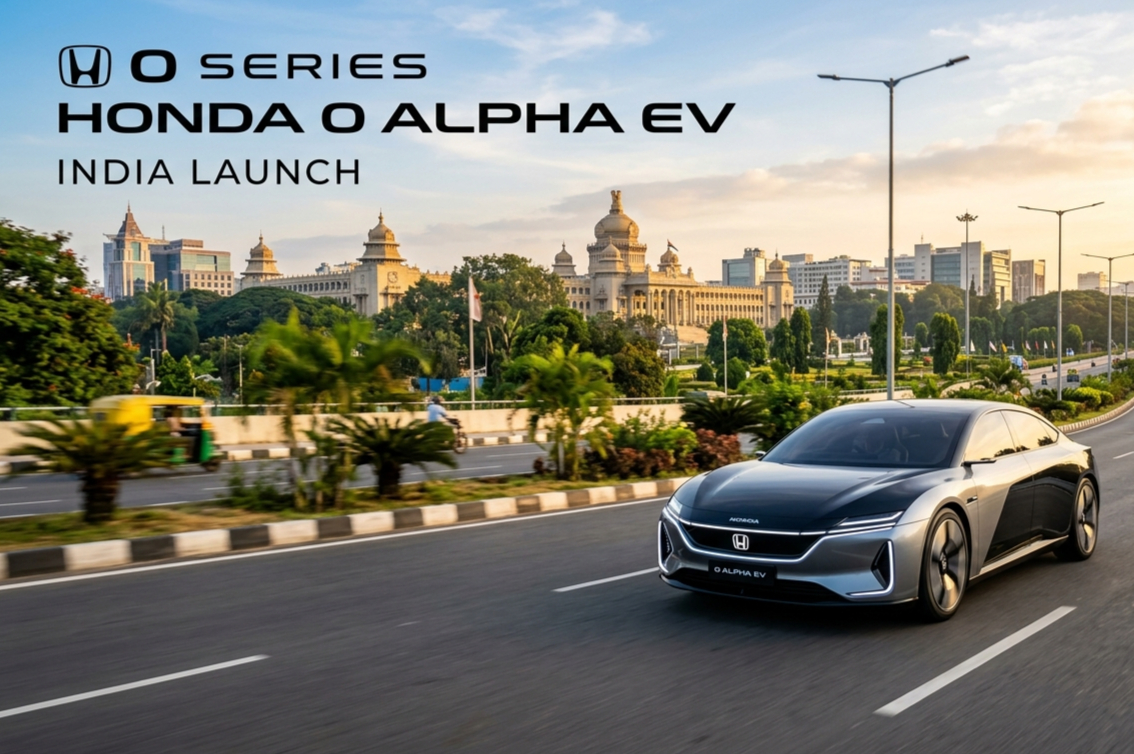
Honda 0 Alpha EV India Launch: Price Offers and Buyer Guide
Honda's first India EV arrives December 2. We break down expected price, range, charging, and whether to wait or buy a Tata, Mahindra, or Hyundai EV now.
## Honda 0 Alpha EV India Launch: What Buyers Need to Know Before December 2
Honda has finally put a date on its first electric car for India. The Honda 0 Alpha EV goes on sale on December 2, according to a Team-BHP source signal, and that single date changes the maths for anyone cross-shopping an electric SUV this winter. If you are waiting for **price offers** before you commit, you now have roughly seven weeks to decide whether to hold your booking on a Hyundai Creta Electric, a Tata Curvv EV, or a [Mahindra BE 6](/blog/hybrid-vs-ev-vs-ice-which-powertrain-suits-your-driving-in-2026), or to gamble on Honda's first attempt.
Here is the uncomfortable part. Honda has not announced Indian pricing, battery size, or localisation levels. So this preview is not a list of cars you can buy today. It is a list of the decisions you are actually facing, ranked by how much they should influence your cheque book. Read it as a buying guide, not a brochure.
## Our picks at a glance
| Rank | Decision path | Best for | Price range (ex-showroom, India) |
|---|---|---|---|
| 1 | Wait for the Honda 0 Alpha EV | Buyers who want the newest platform and can absorb first-year risk | ₹25 lakh to ₹35 lakh (estimated) |
| 2 | Buy a Tata Curvv EV now | Buyers who want a proven India EV with real service depth | ₹17.5 lakh to ₹22 lakh |
| 3 | Buy a Mahindra BE 6 now | Buyers who want range and performance over badge prestige | ₹18.9 lakh to ₹26.9 lakh |
| 4 | Buy a Hyundai Creta Electric now | Buyers who want a familiar nameplate and easy resale | ₹18 lakh to ₹24 lakh |
| 5 | Buy a used EV instead | Buyers who want to test EV ownership with minimal capital at risk | ₹9 lakh to ₹16 lakh |
| 6 | Lease or subscribe for 24 months | Buyers who want the Honda badge without owning a first-gen product | ₹45,000 to ₹75,000 per month |
| 7 | Do nothing until mid-2027 | Buyers who are not in a hurry and want the segment to settle | Not applicable |
### How we picked
- We weighted India-specific factors first: charging network, service centre density, and spare part availability. A great car with a thin dealer network is a bad buy here.
- We treated the December 2 launch as a signal, not a specification. No confirmed Indian range, battery, or price exists yet, so anything quoted is an estimate and labelled as such.
- We ranked by risk-adjusted value, meaning what you actually pay over three years including resale, insurance, and charging, not just the sticker.
- We excluded grey imports and any model without a confirmed India service footprint.
- We cross-checked pricing against current ex-showroom figures for the models already on sale, correct as of October 2026.
### 1. Wait for the Honda 0 Alpha EV
#### Best for buyers who want the newest platform and can absorb first-year risk
**Verdict:** The most interesting option on this list, and the one with the least information available.
Why it is on the list: Honda's 0 Series platform is a ground-up electric architecture, not a petrol car with a battery stuffed in the floor. That matters for interior space, weight distribution, and how the car ages. Honda also has a reputation for build quality that Indian buyers trust, and a first EV from a brand with that history will hold attention. The December 2 date is real. Everything else is not.
Expected price: ₹25 lakh to ₹35 lakh ex-showroom, based on segment positioning against the [Mahindra BE 6](/blog/2026-india-car-launch-calendar-25-upcoming-models-you-can-t-miss) and the higher trims of the Creta Electric. Treat this as a guess, not a quote.
**Pros:**
- Newest platform in the segment, which usually means better packaging and thermal management than converted petrol cars.
- Honda's dealer and service network in India is broad and well regarded.
- Strong brand residual value, which softens the depreciation hit.
**Cons:**
- Zero confirmed Indian range, battery capacity, or charging speed.
- First-year Honda EVs globally have had software and charging teething issues, and India-specific fixes take longer.
**Who should buy:** Buyers who keep cars for five years or more, are not dependent on the car for daily long-distance runs, and can live with a first-generation product.
### 2. Buy a Tata Curvv EV now
#### Best for buyers who want a proven India EV with real service depth
**Verdict:** The safe money, and safe money wins more often than enthusiasts admit.
Why it is on the list: Tata has the widest EV service footprint in India and the Curvv EV has been on sale long enough for real-world range and charging data to exist. You are not guessing. The coupe-SUV body also gives it a distinct look at a price that undercuts most rivals.
Price: ₹17.5 lakh to ₹22 lakh ex-showroom.
**Pros:**
- Largest EV service network in India, which matters more than spec sheets when something breaks.
- Real-world range figures are documented by owners, not just claimed by the company.
- Competitive pricing with frequent **price offers** and exchange bonuses at dealers.
**Cons:**
- Interior materials do not feel as premium as the asking price in top trims.
- Charging speed is adequate, not class-leading.
**Who should buy:** Buyers who want an EV this month, not in December, and who value a dealer within driving distance over a newer badge.
### 3. Buy a Mahindra BE 6 now
#### Best for buyers who want range and performance over badge prestige
**Verdict:** The enthusiast pick, and the one that makes the Honda wait feel less urgent.
Why it is on the list: The BE 6 delivers the kind of range and acceleration numbers that make the segment interesting, and Mahindra has priced it aggressively against larger SUVs. If you care about driving rather than badge, this is where the value sits.
Price: ₹18.9 lakh to ₹26.9 lakh ex-showroom.
**Pros:**
- Long range on the larger battery pack, among the best in the segment.
- Rear-wheel drive layout gives it genuinely enjoyable dynamics.
- Mahindra's EV manufacturing scale is growing, which helps parts availability over time.
**Cons:**
- Styling is polarising, and resale value for bold designs is unpredictable.
- Service network for EVs is still thinner than Tata's outside major cities.
**Who should buy:** Buyers who drive themselves, care about range, and are willing to accept a design that divides opinion.
### 4. Buy a Hyundai Creta Electric now
#### Best for buyers who want a familiar nameplate and easy resale
**Verdict:** The least exciting choice, and possibly the smartest one.
Why it is on the list: The Creta name carries enormous weight in India, and the electric version inherits that recognition along with Hyundai's strong dealer network. Resale will likely be easier than for any newer or more niche badge. For a buyer who wants an EV that nobody will question, this is it.
Price: ₹18 lakh to ₹24 lakh ex-showroom.
**Pros:**
- Nameplate recognition makes resale and insurance simpler.
- Hyundai's service quality is consistently rated well in India.
- Feature list is comprehensive, including the connected car suite buyers expect.
**Cons:**
- Based on a platform shared with petrol models, so packaging is not EV-optimised.
- Hyundai rarely discounts heavily, so **price offers** are thinner than Tata's.
**Who should buy:** Buyers who want zero surprises and plan to sell within four years.
### 5. Buy a used EV instead
#### Best for buyers who want to test EV ownership with minimal capital at risk
**Verdict:** The cheapest way to find out whether an EV suits your life before committing ₹25 lakh.
Why it is on the list: Two-year-old EVs from Tata and MG are now available at prices that make the depreciation work in your favour. You get a real car, real charging experience, and a much smaller financial commitment. If it does not work out, you sell and lose far less than on a new purchase.
Price: ₹9 lakh to ₹16 lakh for a two to three year old EV with reasonable mileage.
**Pros:**
- Depreciation has already happened, so you avoid the steepest part of the curve.
- Battery warranties often transfer to the second owner, which covers the biggest risk.
- Lets you learn your real charging habits before spending new-car money.
**Cons:**
- Battery health varies wildly between examples, so a proper inspection is essential.
- Older models charge slowly by current standards.
**Who should buy:** First-time EV buyers who are not certain the switch will stick.
### 6. Lease or subscribe for 24 months
#### Best for buyers who want the Honda badge without owning a first-generation product
**Verdict:** The underrated option if you want a new EV but not the ownership risk.
Why it is on the list: Leasing and subscription plans have expanded in Indian metros, and they let you drive a new EV without absorbing depreciation or resale uncertainty. If the Honda 0 Alpha EV turns out to have first-year issues, you hand back the keys. If it is brilliant, you buy one in 2028 when the bugs are gone.
Price: ₹45,000 to ₹75,000 per month depending on model and term.
**Pros:**
- No depreciation risk and no resale headache.
- Maintenance and sometimes insurance are bundled.
- Lets you switch models as the market matures.
**Cons:**
- Monthly cost over 24 months can exceed the depreciation you would have suffered on a purchase.
- Mileage caps and wear-and-tear charges catch people out.
**Who should buy:** Buyers in metros who value flexibility and change cars often.
### 7. Do nothing until mid-2027
#### Best for buyers who are not in a hurry and want the segment to settle
**Verdict:** Sometimes the best decision is to keep your current car for another year.
Why it is on the list: The India EV segment is moving fast. By mid-2027 there will be more models, more charging infrastructure, and more real-world data on the Honda 0 Alpha EV. If your current car works, waiting costs you nothing except the novelty.
Price: Not applicable.
**Pros:**
- More information means better decisions and stronger **price offers** as competition intensifies.
- Charging infrastructure will be meaningfully better in twelve months.
- You avoid being an unpaid beta tester for any brand.
**Cons:**
- You keep paying running costs on your current car.
- Waiting has an opportunity cost if fuel prices rise sharply.
**Who should buy:** Anyone whose current vehicle is reliable and who feels no urgency to switch.
## How to choose the right path for you
- Set your maximum monthly outgo first, not the sticker price. Insurance, charging, and tyres add up faster on EVs than most buyers expect.
- Check whether a service centre for your chosen brand exists within 50 km. If it does not, remove that option from your list.
- Measure your real weekly driving. If you rarely exceed 200 km between charges, range anxiety is a marketing problem, not a practical one.
- Ask the dealer for the on-road price in writing, including any **price offers** and their expiry dates. Verbal discounts evaporate at delivery.
- Decide whether you are buying a car or buying into a platform. If it is the latter, waiting for the Honda 0 Alpha EV makes sense. If it is the former, buy what exists today.
## Our take
Wait for the December 2 announcement before you sign anything, but do not wait for the Honda 0 Alpha EV itself unless you specifically want a Honda. The Tata Curvv EV and Mahindra BE 6 already deliver most of what the Honda promises, with service networks and owner data that Honda cannot match on day one. If Honda launches below ₹28 lakh with a genuine 450 km plus real-world range, that changes everything, and we will say so. If it launches above ₹32 lakh, buy the Mahindra or the Creta Electric and put the difference into a home charger.
## FAQ
**When exactly does the Honda 0 Alpha EV launch in India?**
December 2, according to the launch date reported by Team-BHP. Deliveries typically follow within weeks, though Honda has not confirmed a delivery timeline.
**How much will the Honda 0 Alpha EV cost in India?**
No official price exists. Based on segment positioning, expect ₹25 lakh to ₹35 lakh ex-showroom. Anything outside that range would be a surprise in either direction.
**Should I wait for the Honda 0 Alpha EV or buy an EV now?**
If you need a car this quarter, buy a Tata Curvv EV or Mahindra BE 6. If you can wait until December and want the newest platform, wait for the announcement and decide with real numbers in front of you.
Frequently asked questions
When exactly does the Honda 0 Alpha EV launch in India?
December 2, according to the launch date reported by Team-BHP. Deliveries typically follow within weeks, though Honda has not confirmed a delivery timeline.
How much will the Honda 0 Alpha EV cost in India?
No official price exists. Based on segment positioning, expect ₹25 lakh to ₹35 lakh ex-showroom. Anything outside that range would be a surprise in either direction.
Should I wait for the Honda 0 Alpha EV or buy an EV now?
If you need a car this quarter, buy a Tata Curvv EV or Mahindra BE 6. If you can wait until December and want the newest platform, wait for the announcement and decide with real numbers in front of you.
 CarsbikesPrices