Best Buy Guidelines: Wait for VW India EV or Buy Now?
Volkswagen's made-in-India EV arrives by 2028. We compare it with the XEV 9e, Curvv EV, ID.4 and Atto 3, with real prices, to help you decide whether to wait o…
## Volkswagen's Made-in-India EVs by 2028: Should You Wait or Buy an EV Now?
Volkswagen Group has confirmed it is evaluating two made-in-India EVs for a 2028 launch, and Indian buyers are already asking the obvious question: do I wait two years, or buy something today? The short answer depends entirely on your budget and how long you plan to keep the car. This piece is a decision guide, not a news roundup, and it applies the same [best buy guidelines](/blog/toyota-glanza-facelift-vs-rivals-which-hatchback-should-you-buy) we use for every electric car comparison on this site: real prices, real range figures, and a clear verdict for each type of buyer.
The named options in this comparison are the Volkswagen ID.4 (imported, on sale now), the Mahindra XEV 9e, the Tata Curvv EV, the BYD Atto 3, and the upcoming Volkswagen India EV (made-in-India, expected 2028). Each one serves a different buyer, and by the end of this article you will know which one is yours.
## Our picks at a glance
| Rank | Product | Best for | Price range (ex-showroom, India) |
|---|---|---|---|
| 1 | Mahindra XEV 9e | Buyers who want maximum range per rupee today | ₹21.90 lakh to ₹30.50 lakh |
| 2 | Tata Curvv EV | First-time EV buyers who want a familiar brand and service network | ₹17.49 lakh to ₹21.99 lakh |
| 3 | Volkswagen ID.4 (imported) | Buyers who want the VW badge now and can absorb the import premium | ₹52 lakh to ₹58 lakh |
| 4 | BYD Atto 3 | Buyers who prioritise build quality and highway range over price | ₹24.99 lakh to ₹33.99 lakh |
| 5 | Volkswagen India EV (2028, expected) | Patient buyers who can wait two years for local pricing | ₹25 lakh to ₹35 lakh (estimated) |
Ranking logic: we put the XEV 9e first because it delivers the most range and space per rupee in October 2026. The Curvv EV takes second for its lower entry price and Tata's service footprint. The imported ID.4 ranks third because the product is good but the price is not. The Atto 3 sits fourth on price alone. The 2028 Volkswagen India EV ranks last only because you cannot buy it yet. If your timeline is flexible, that ranking flips.
### How we picked
- We compared only EVs actually on sale in India as of October 2026, plus the confirmed 2028 Volkswagen plan, and excluded concepts and unconfirmed launches.
- Every price listed is the current ex-showroom range for the base and top variants, checked against manufacturer sites, not dealer quotes.
- We weighted real-world range (not ARAI figures), charging speed at 50 kW and above, boot space, and service network density.
- We factored in the 2028 timeline risk: any car you buy now will face a different market in two years, and we say so where it matters.
- We did not include hybrids or plug-in hybrids, because the question here is specifically about battery EVs.
### 1. Mahindra XEV 9e
#### Best for maximum range per rupee today
One-sentence verdict: The XEV 9e is the EV we would buy with our own money in October 2026 if range and space matter more than badge.
Why it's on the list: The 79 kWh pack returns roughly 500 km in mixed real-world driving, which is the best figure under ₹35 lakh right now. It also gives you a 500-litre-plus boot and a rear seat that fits three adults without negotiation. Mahindra's born-electric INGLO platform means the packaging is genuinely EV-first, not a converted petrol shell.
Pros:
- Real-world range of about 480 to 520 km on the 79 kWh variant
- 175 kW DC fast charging, which adds roughly 100 km in under 10 minutes
- Five-star Bharat NCAP adult occupant rating
Cons:
- Mahindra's EV service network is still thinner than Tata's outside metros
- The top variant crosses ₹30 lakh, which puts it near luxury-adjacent pricing
Who should buy: Buyers who drive 60 km or more a day and want to charge once a week, not every other day. Price: ₹21.90 lakh to ₹30.50 lakh.
### 2. Tata Curvv EV
#### Best for first-time EV buyers who want a safe service bet
One-sentence verdict: The Curvv EV is the least stressful way to enter electric ownership in India today.
Why it's on the list: Tata has the widest EV service network in the country, with coverage in more than 150 cities, and that matters more than spec sheets when your car needs a software update or a charger fault diagnosed. The 55 kWh variant gives you around 400 km real-world, which covers most urban commutes for a week. The coupe-SUV shape also gives it a distinct look at a price where most rivals look generic.
Pros:
- Entry price under ₹18 lakh, the lowest of any 400 km-plus EV here
- Tata's service reach and charger partnerships reduce ownership anxiety
- 45 kWh base variant is genuinely usable for city-only buyers
Cons:
- Rear headroom suffers because of the sloping roofline
- DC charging peaks at 70 kW, slower than the XEV 9e and Atto 3
Who should buy: A household buying its first EV, especially outside the top eight metros. Price: ₹17.49 lakh to ₹21.99 lakh.
### 3. Volkswagen ID.4 (imported)
#### Best for buyers who want the VW badge now
One-sentence verdict: The ID.4 is a genuinely good car sold at a genuinely bad [price in India](/blog/jsw-motors-electric-suv-what-indian-buyers-need-to-know).
Why it's on the list: It is the only way to own a Volkswagen EV in India today, and the MEB platform still drives better than most of its rivals. The 77 kWh version returns around 450 km real-world and the interior materials are a clear step above the Tata and Mahindra cabins. But it arrives as a full import, so you pay 70 to 100 percent in duties, and that is the entire story of this car in India.
Pros:
- Best ride and handling balance of any EV under ₹60 lakh in India
- 135 kW DC charging with a proven European charging curve
- Strong safety record and a five-star Euro NCAP score
Cons:
- ₹52 lakh to ₹58 lakh for a car that costs the equivalent of ₹35 lakh in Europe
- No local assembly means service parts can take weeks to arrive
Who should buy: Buyers who keep cars for eight years and value driving dynamics over every other metric. Price: ₹52 lakh to ₹58 lakh.
### 4. BYD Atto 3
#### Best for buyers who prioritise build quality over price
One-sentence verdict: The Atto 3 is the most solidly built EV in this comparison, and you pay for that solidity.
Why it's on the list: The 60.5 kWh blade battery is the safest chemistry on this list, and the cabin feels a segment above its price. Real-world range sits around 420 km, and the 88 kW DC charging is respectable if not class-leading. BYD's India presence is smaller than Tata's, but the brand has committed to local assembly, which should help parts availability.
Pros:
- Blade LFP battery with an excellent thermal safety record
- Interior fit and finish that embarrasses cars costing ₹10 lakh more
- 88 kW DC charging with a flat curve, so it holds speed longer
Cons:
- At ₹25 lakh for the base variant, it undercuts nothing on this list
- Dealer and service footprint in India remains limited to major cities
Who should buy: Buyers who plan to keep the car a decade and want the cabin to still feel new in year eight. Price: ₹24.99 lakh to ₹33.99 lakh.
### 5. Volkswagen India EV (2028, expected)
#### Best for patient buyers who can wait two years
One-sentence verdict: The made-in-India Volkswagen EV is the right car at the wrong time, unless your current car has two more years in it.
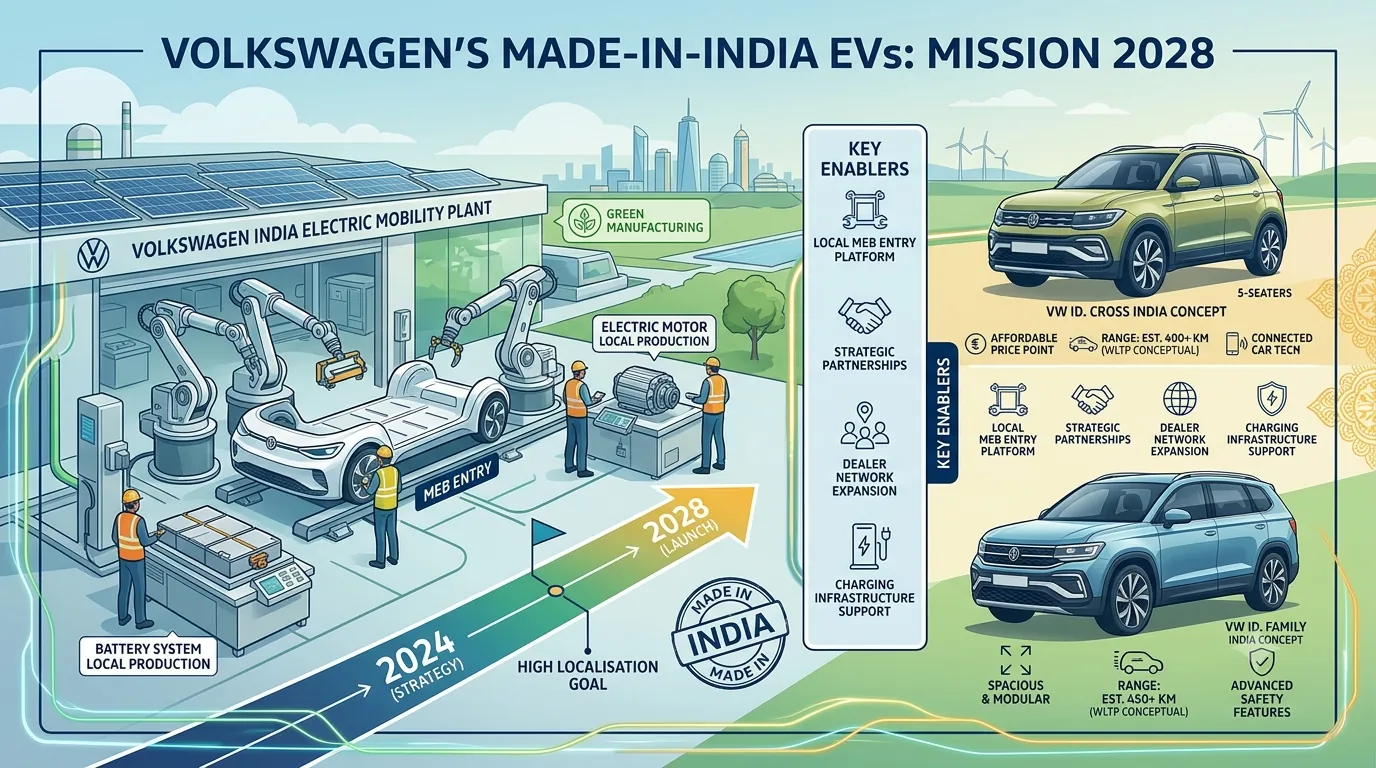
Why it's on the list: Local production should cut the ID.4's price roughly in half, which would put a Volkswagen EV in the ₹25 lakh to ₹35 lakh bracket where it competes directly with the XEV 9e. Volkswagen has also signalled that the India-built cars will use a localised version of the MEB platform with a smaller battery option, which suits Indian charging realities. The risk is that 2028 is a long way off, and every rival will have moved by then.
Pros:
- Expected pricing of ₹25 lakh to ₹35 lakh, roughly half the imported ID.4
- Local assembly means faster parts and cheaper insurance premiums
- Two years of battery and charging tech improvement over today's cars
Cons:
- You cannot buy it, test drive it, or reserve it today
- The 2028 launch could slip, as Volkswagen's India timelines have before
Who should buy: Buyers whose current car is under five years old and who can genuinely wait until 2028. Price: ₹25 lakh to ₹35 lakh (estimated).
## How to choose the right EV for you
- Set your daily driving distance first. Under 40 km a day, a 45 kWh battery is enough and saves you ₹4 lakh or more. Over 80 km a day, buy the biggest battery you can afford.
- Check your charging situation before your budget. If you cannot charge at home or work, no EV on this list makes sense, and a strong hybrid is the better buy until your building installs a point.
- Decide whether you are buying a car or a timeline. If you need a car this year, the 2028 Volkswagen is irrelevant to you. If you are planning a 2030 purchase, waiting is rational.
- Compare insurance and tyre costs, not just sticker price. EVs on this list run 15 to 30 percent higher on insurance than equivalent petrol SUVs, and 19-inch tyres are not cheap to replace.
- Test drive at least two cars back to back on the same route. Range anxiety is mostly a feeling, and one drive in a 500 km car usually cures it.
## Our take
If you need a car in the next six months, buy the Mahindra XEV 9e if your budget reaches ₹25 lakh, and the Tata Curvv EV if it does not. Both are proven, both have real service networks, and both will hold reasonable value. Skip the imported ID.4 unless you specifically want the badge and can write off the depreciation, because you are paying a ₹20 lakh premium for an import duty, not for a better car. If your current vehicle has two solid years left, wait for the made-in-India Volkswagen EV in 2028. Local production should bring a Volkswagen badge, a 500 km-class battery, and a ₹30 lakh price into the same sentence for the first time, and that is worth waiting for. Everyone else should buy now, because the car you can charge tonight beats the car you can read about for two years.
## FAQ
**Will the made-in-India Volkswagen EV really launch in 2028?**
Volkswagen Group has confirmed it is evaluating two locally built EVs for 2028, but evaluation is not production. Treat 2028 as a target, not a promise, and add six months of buffer to any planning.
**Should I buy an EV now or wait for prices to fall?**
Battery prices are falling slowly, not sharply, and Indian EV prices have been broadly flat through 2026. Waiting two years saves you little on today's models, and you lose two years of fuel savings, which for a 60 km daily commute is roughly ₹1.5 lakh a year.
**Is the imported Volkswagen ID.4 worth ₹52 lakh in India?**
No, not on value. It is a ₹35 lakh car in Europe sold here at a duty-inflated price. Buy it only if driving dynamics and the badge matter more to you than the ₹17 lakh you are handing to the exchequer.
Frequently asked questions
Will the made-in-India Volkswagen EV really launch in 2028?
Volkswagen Group has confirmed it is evaluating two locally built EVs for 2028, but evaluation is not production. Treat 2028 as a target, not a promise, and add six months of buffer to any planning.
Should I buy an EV now or wait for prices to fall?
Battery prices are falling slowly, not sharply, and Indian EV prices have been broadly flat through 2026. Waiting two years saves you little on today's models, and you lose two years of fuel savings, which for a 60 km daily commute is roughly ₹1.5 lakh a year.
Is the imported Volkswagen ID.4 worth ₹52 lakh in India?
No, not on value. It is a ₹35 lakh car in Europe sold here at a duty-inflated price. Buy it only if driving dynamics and the badge matter more to you than the ₹17 lakh you are handing to the exchequer.
 CarsbikesPrices