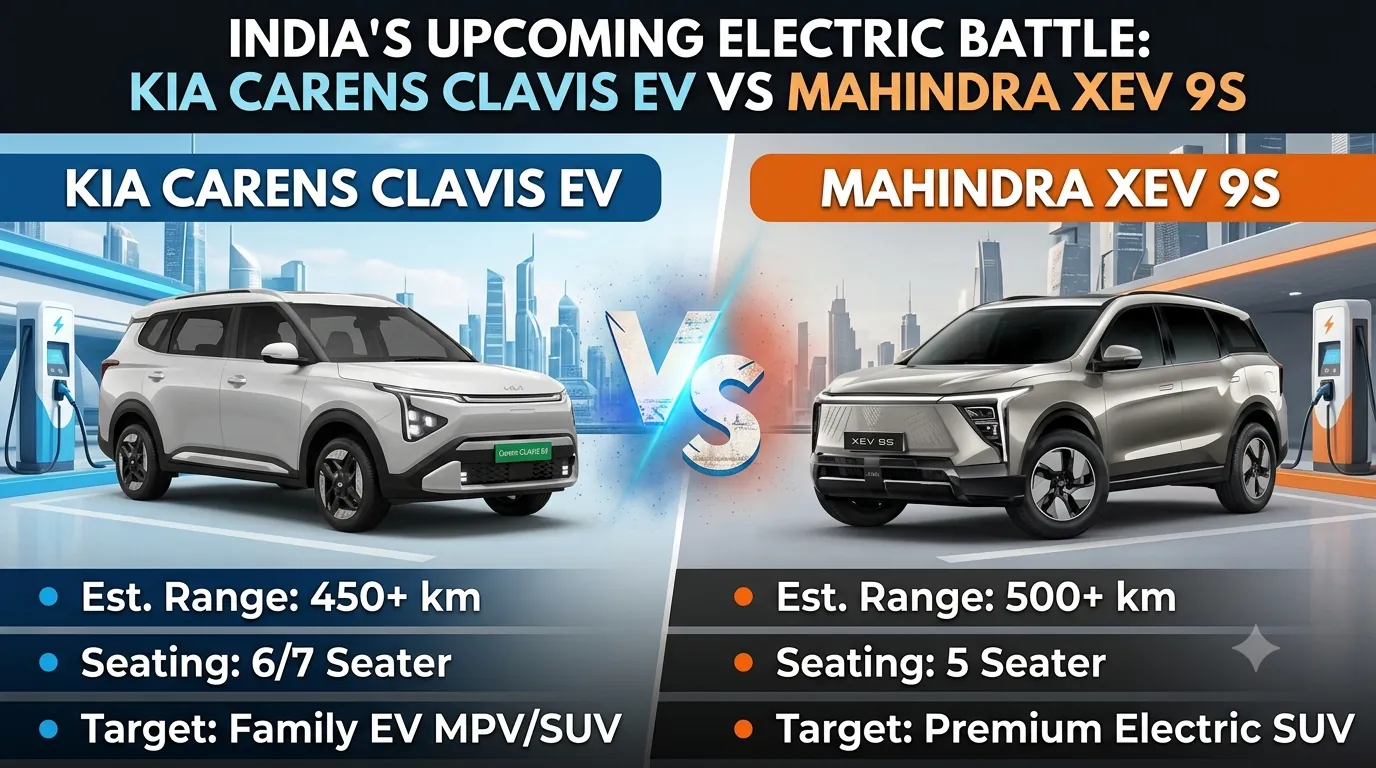
Kia Carens Clavis EV vs Mahindra XEV 9S compared on range, space, price and value. Find out which 3-row family EV deserves your money in 2026.
## Kia Carens Clavis EV vs Mahindra XEV 9S: The Family EV Decision
Three rows, three kids, one charging cable, and a father-in-law who wants to know why you are not buying a Toyota Innova instead. That is the conversation happening in Indian living rooms every weekend in 2026. The Kia Carens Clavis EV and the Mahindra XEV 9S both answer the same question, and they answer it very differently.
Kia's Carens Clavis EV is the practical, van-shaped MPV that happens to run on electrons. Mahindra's XEV 9S is the coupe-SUV that swallows seven people when you need it to. If you are shopping for the best electric car range in india alongside genuine third-row space, these two sit at the top of a very short list.
Here is the honest breakdown: what each costs, what each actually does, and who should walk away with which.
## What Each One Costs in 2026
Prices are ex-showroom, and they matter more than any spec sheet.
| | Kia Carens Clavis EV | Mahindra XEV 9S |
|---|---|---|
| Price range (ex-showroom) | Rs 18.5 lakh to Rs 25 lakh | Rs 22 lakh to Rs 29 lakh |
| Battery options | 42 kWh and 51.4 kWh | 59 kWh and 79 kWh |
| Claimed range (MIDC) | 420 km and 490 km | 535 km and 656 km |
| Real-world range (mixed) | 320 km to 400 km | 430 km to 540 km |
| Seating | 6 or 7 | 6 or 7 |
| Third-row type | Bench, usable by adults on short trips | Bench, tight for adults |
| DC fast charging | 10 to 80 percent in about 40 min | 20 to 80 percent in about 30 min |
| Boot with all rows up | Around 200 litres | Around 210 litres |
The Kia undercuts the Mahindra by roughly Rs 3.5 lakh at the entry point. That gap buys a lot of electricity. It also buys a smaller battery and less range, which is the trade you are actually making.
## Range: The Number That Decides Everything
Mahindra wins this round, and it is not close. The 79 kWh XEV 9S returns over 500 km in real mixed driving, which means a Delhi to Jaipur run with air conditioning and four passengers does not require a charging stop. The 51.4 kWh Carens Clavis EV will do roughly 380 km in the same conditions, so the same trip needs one top-up.
For a family that mostly drives within a city and charges at home, 380 km is plenty. For a family that does two or three long highway runs a month, the Mahindra's extra 150 km is the difference between a relaxed drive and a planning exercise.
Kia's charging curve is also slower. Forty minutes versus thirty is not a disaster, but on a highway with kids in the car, ten minutes at a charger feels like an hour.
### Where the Kia fights back
The Carens Clavis EV is lighter and more efficient per kilometre. In pure city running, the gap between the two narrows to around 60 to 80 km of usable range, which most owners will never notice. If your longest regular trip is 40 km each way, the Kia is the smarter spend.
## Space: Two Different Ideas of a Third Row
Neither of these is a Toyota Innova. Let us be clear about that before anyone signs a cheque.
The Kia Carens Clavis EV has the better third row. The roofline is taller, the floor is flatter, and adults under 5 foot 8 can sit there for a 45 minute airport run without filing a complaint. Access is easier too, because the second row slides and folds in one motion.
The Mahindra XEV 9S has the more dramatic cabin. The sloping roof eats headroom in row three, and getting back there requires more contortion. It works for children and teenagers. It does not work for your parents on a Kerala road trip.
Second row is a wash. Both offer generous legroom, rear air vents, and charging points.
### The boot problem
Here is the thing nobody mentions in showrooms. With all seven seats up, both cars give you about 200 litres. That is two soft bags and a laptop. Any family of five doing a weekend trip will fold the third row and use the space, which means you bought a seven-seater to use as a five-seater. That is true of almost every 3-row electric car india sells today, and it is worth admitting before you pay for the extra seats.
## Features and Cabin Quality
Kia's cabin is conventional and well built. Physical buttons for climate control, a clean twin-screen layout, and materials that will survive a decade of school runs. The Carens Clavis EV feels like a car designed by people who have children.
Mahindra's cabin is a statement. Triple screens, a heads-up display, ADAS as standard on higher trims, and a Sony audio system that genuinely impresses. It also has more software, which means more software to go wrong. Early owners have reported occasional glitches with the connected car app.
If you want a car that feels premium, Mahindra. If you want a car that feels indestructible, Kia.
## Charging and Ownership Reality
Both brands now offer an 8-year or 160,000 km battery warranty in India, which removes the biggest fear from the purchase.
The real difference is the dealer and service network. Kia has over 500 touchpoints. Mahindra's EV-specific service network is smaller but growing, and its charging partnerships with Tata Power and Statiq cover most highways. For a buyer in a metro, this is a non-issue. For a buyer in a tier-two town, check where your nearest authorised EV service centre actually is before you sign.
Running costs are similar. Roughly Rs 1.5 to Rs 2 per kilometre on home charging, versus Rs 7 to Rs 9 for a petrol MPV. Over 15,000 km a year, that is a saving of around Rs 90,000 annually. Both cars pay for their premium in about four years.
## Our Take: Who Should Buy Which
### Buy the Kia Carens Clavis EV if:
- Your budget tops out around Rs 25 lakh on road
- You charge at home and rarely exceed 300 km in a day
- You genuinely need a third row that adults can use
- You value simplicity over screens
### Buy the Mahindra XEV 9S if:
- You can stretch to Rs 29 lakh and want the 79 kWh battery
- You do monthly highway trips and hate planning charging stops
- You want the best electric car range in india in this price bracket
- You are buying for four or five people, with occasional seven
### Buy neither if:
You need a true seven-seater for long family trips. In that case, wait for the next generation of larger three-row EVs arriving in 2027, or buy a diesel Innova today and revisit electric in three years. There is no shame in that answer.
## FAQ
### Is the Mahindra XEV 9S worth the extra Rs 4 lakh over the Kia Carens Clavis EV?
Only if you do regular highway driving. The extra range and faster charging justify the premium for long-distance families. For pure city use, the Kia is the better value.
### Which has the better real-world range in Indian conditions?
The Mahindra XEV 9S with the 79 kWh battery, by around 130 to 150 km in mixed driving with air conditioning on.
### Can adults sit in the third row of either car?
Yes in the Kia Carens Clavis EV for short journeys. In the Mahindra XEV 9S, the third row is best reserved for children and teenagers.
Frequently asked questions
Where the Kia fights back
The Carens Clavis EV is lighter and more efficient per kilometre. In pure city running, the gap between the two narrows to around 60 to 80 km of usable range, which most own
Only if you do regular highway driving. The extra range and faster charging justify the premium for long-distance families. For pure city use, the Kia is the better value.
Which has the better real-world range in Indian conditions?
The Mahindra XEV 9S with the 79 kWh battery, by around 130 to 150 km in mixed driving with air conditioning on.
Can adults sit in the third row of either car?
Yes in the Kia Carens Clavis EV for short journeys. In the Mahindra XEV 9S, the third row is best reserved for children and teenagers.
 CarsbikesPrices