
CarsbikesPrices logo CarsbikesPrices

Cheapest Electric Hybrid SUV? EX90 vs iX vs EQS

Volvo EX90 vs BMW iX vs Mercedes EQS SUV compared on India price, range and seats. See which luxury electric SUV actually fits your garage in 2026.
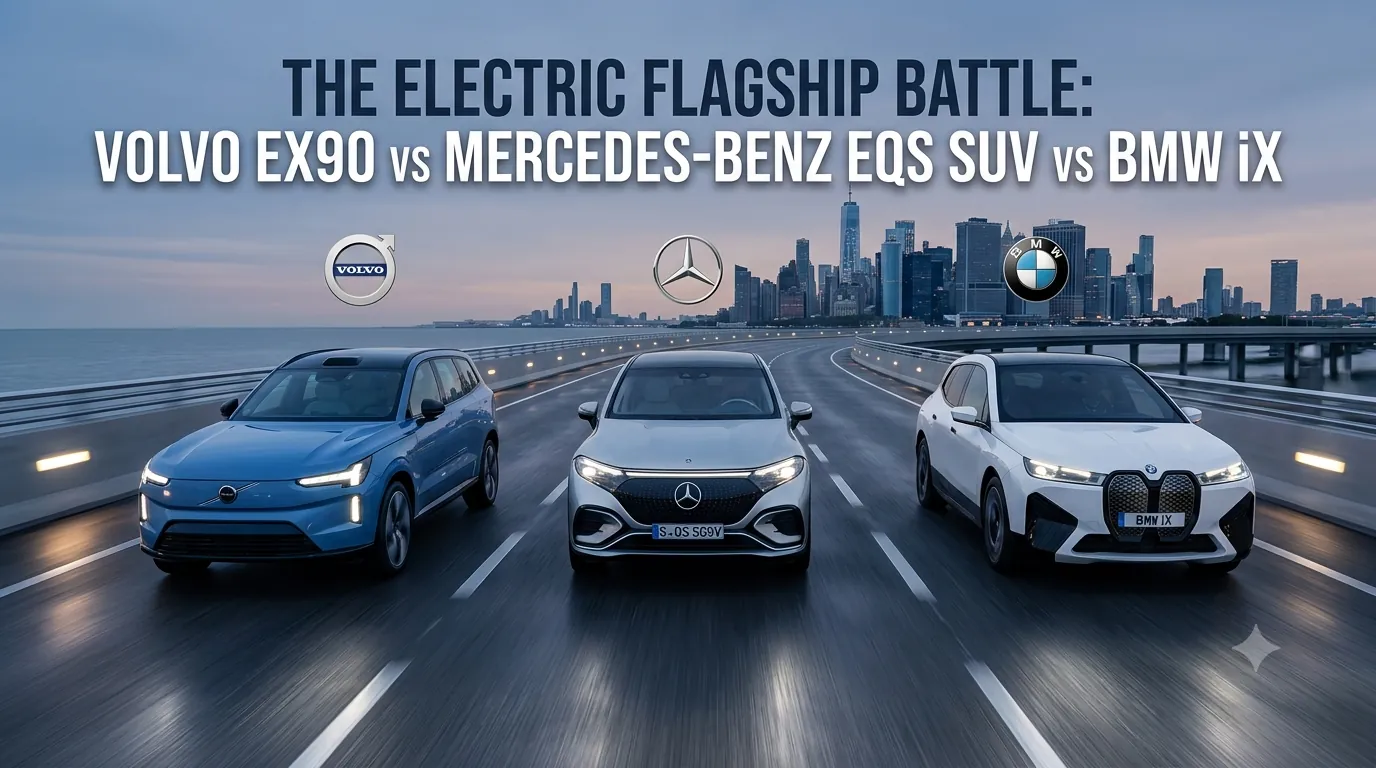
Volvo EX90 vs Mercedes EQS SUV vs BMW iX: Luxury EV Buyer's Guide — illustrative featured image
## Three luxury EVs, one uncomfortable question Walk into any Volvo showroom in Delhi or Mumbai this month and the salesperson will steer you toward the EX90. Walk into a BMW dealer and it is the iX. Walk into Mercedes and it is the EQS SUV. All three want your money, all three cost more than a decent flat in most Indian cities, and all three will happily tell you they are the future. Here is the catch. If you are searching for the **cheapest electric hybrid suv** in this segment, none of these three actually qualifies. They are all pure electric, and the hybrid badge does not apply. That confusion trips up a lot of buyers, so let us clear it before we go further, then get to the real comparison. We are looking at the [Volvo EX90](/blog/volvo-ex90-vs-es90-which-luxury-ev-fits-your-lifestyle), the Mercedes EQS SUV, and the BMW iX. The EX90 is for the family buyer who wants seven seats and safety tech without paying Mercedes money. The EQS SUV is for the rear-seat passenger who wants a lounge on wheels. The BMW iX is for the driver who still wants the car to feel like a car. All three are on sale in India in 2026, all three are imported, and all three carry import duties that will make you wince. ## What these cars actually cost in India Let us get the numbers out first, because everything else is secondary. | Model | India price (ex-showroom) | Range (WLTP) | Seats | Charging peak | |---|---|---|---|---| | Volvo EX90 Twin Motor | Rs 1.25 crore approx | 600 km | 7 | 250 kW | | BMW iX xDrive50 | Rs 1.40 crore approx | 630 km | 5 | 195 kW | | Mercedes EQS 580 4MATIC SUV | Rs 1.60 crore approx | 600 km | 5 | 200 kW | These are ex-showroom figures and they move with the rupee, with CBU duty changes, and with whatever offer the dealer is running that month. On-road, add another 15 to 20 percent depending on state. Maharashtra and Karnataka will hurt more than Gujarat. The EX90 undercuts the other two by a meaningful margin. That is the single most important fact in this article. Volvo has positioned the EX90 as the value play in a segment where value is rare, and it has done so without stripping the car down to a bare shell. ## Range is not the story you think it is Every one of these cars claims around 600 km on the WLTP cycle. Ignore that number for a moment. Real world Indian range, with air conditioning running, highway speeds, and our road surfaces, lands somewhere between 400 and 450 km for all three. The differences between them are smaller than the marketing suggests. What actually separates them is charging speed and charging network access. The EX90 takes 250 kW peak, which is the fastest here. BMW sits at 195 kW, Mercedes at 200 kW. In practice, on a 50 kW public charger, which is what most of India still has, all three will fill at the same slow rate. The advantage only shows up on a 150 kW or higher DC charger, and those are still concentrated on the Mumbai-Pune and Delhi-Jaipur corridors. ### What this means for you - If you charge at home and rarely drive beyond 300 km in a day, range differences between these three are irrelevant. - If you do regular intercity runs, the EX90's faster peak charging is a genuine edge, but only on specific routes. - If you live in a city with poor charging infrastructure, none of these cars is a smart buy yet. ## The EX90 vs BMW iX question This is the comparison most of our readers ask about, so let us take it head on. The BMW iX is a five-seater. The Volvo EX90 is a seven-seater. That is the whole argument for a lot of families, and it ends there. If you have three children, or you regularly carry parents and in-laws, the iX simply cannot do the job. No amount of BMW driving dynamics fixes a missing third row. If you do not need seven seats, the iX becomes very compelling. It drives better than the Volvo. The steering has more feel, the chassis is more willing, and the cabin materials feel a rung above. BMW has been building electric cars for longer and it shows in the refinement. The EX90 counters with safety. Volvo's lidar and sensor suite is standard, not optional. The cabin is calmer and more minimalist. And it costs roughly Rs 15 lakh less, which in this segment is not nothing. Our read: family first, buy the EX90. Driver first, buy the iX. ## Where Mercedes fits The EQS SUV is the most expensive and the least obviously justified of the three. It is beautifully built. The rear seat is the best place to be in any of these cars. The hyperscreen is genuinely impressive the first ten times you see it. But it is a five-seater at a seven-seater price, and its range and charging figures do not beat the cheaper Volvo. Mercedes is selling badge, comfort, and rear-seat luxury. For a buyer who is chauffeured, that is a real proposition. For a buyer who drives themselves, the iX does the same job for less. ## What we recommend For a family of five or more in India who wants a luxury [electric SUV](/blog/volvo-ex90-india-launch-price-features-and-everything-else) and cares about total cost: **Volvo EX90**. It is the cheapest of the three, the only seven-seater, and it has the fastest charging. That combination is hard to argue with. For a driver who wants the best electric SUV to actually drive: **BMW iX**. It is the most satisfying behind the wheel and the cabin will age better than the Mercedes. For a buyer who is mostly a passenger and wants maximum comfort: **Mercedes EQS SUV**. Just know you are paying a premium for the rear seat and the badge. And if you are genuinely looking for the cheapest electric hybrid SUV in India, look elsewhere entirely. The luxury plug-in hybrid space is thin, and none of these three is in it. The closest alternatives sit a segment or two below, and they compromise on range, space, or both. ## FAQ **Is the Volvo EX90 a hybrid?** No. It is a fully electric SUV. Volvo does not offer a hybrid version of the EX90 in India. If a dealer tells you otherwise, walk away. **Which of these three has the longest real world range in India?** They are close enough that driving style matters more than the badge. Expect 400 to 450 km from all three in mixed Indian conditions. The EX90 charges fastest, which matters more than the range figure on paper. **Should I buy any of these in 2026 or wait?** If you need seven seats now, buy the EX90. If you do not, wait twelve months. Charging infrastructure is improving fast and prices on imported EVs have been drifting downward. The 2027 model year will likely bring better value across all three.

Frequently asked questions

Is the Volvo EX90 a hybrid?

No. It is a fully electric SUV. Volvo does not offer a hybrid version of the EX90 in India. If a dealer tells you otherwise, walk away.

Which of these three has the longest real world range in India?

They are close enough that driving style matters more than the badge. Expect 400 to 450 km from all three in mixed Indian conditions. The EX90 charges fastest, which matters more than the range figure on paper.

Should I buy any of these in 2026 or wait?

If you need seven seats now, buy the EX90. If you do not, wait twelve months. Charging infrastructure is improving fast and prices on imported EVs have been drifting downward. The 2027 model year will likely bring better value across all three.

Awin