CarsbikesPrices logo CarsbikesPrices

Car Buying Guide for Beginners: Safest Cars 2026

IIHS safety ratings explained for Indian buyers. See which 2026 cars earn their stars, what they cost on-road, and the one variant trap to avoid.
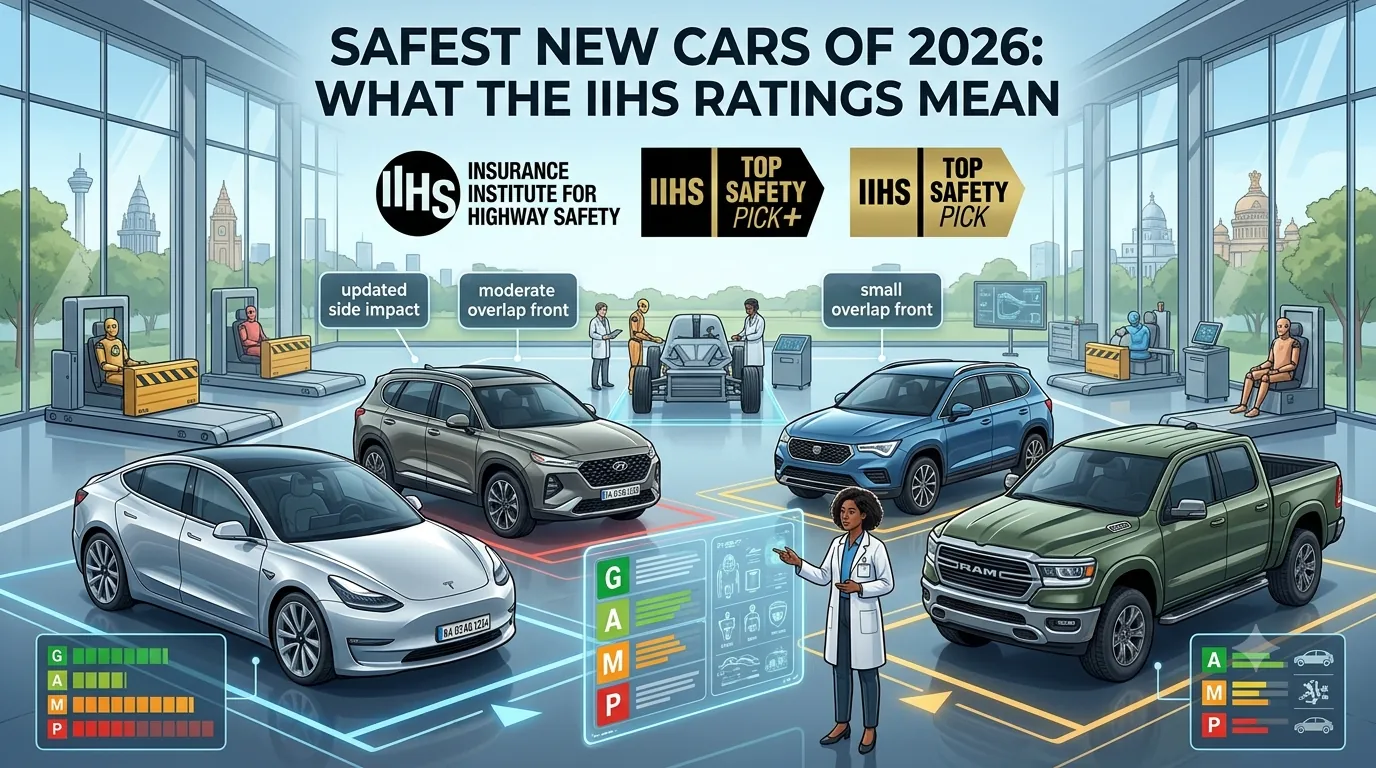
Safest New Cars of 2026: What the IIHS Ratings Mean for Indian Buyers — illustrative featured image
## The ₹12 Lakh Question A friend in Pune messaged me last week with a screenshot: a 2026 hatchback, five stars in one crash test, and a dealer promising "international safety standards." He wanted to know if it was worth ₹40,000 more than the version without the extra airbags. I asked him which test, which body, and whether the rating applied to the car sold in India or the one sold in Europe. He went quiet. That silence is where most Indian car buyers live. This is the gap a good **car [buying guide](/blog/ducati-hypermotard-v2-vs-v2-sp-which-one-should-you-buy) for beginners** has to close. Global crash test scores, including the IIHS safety ratings that Consumer Reports and every US outlet lean on, are real and rigorous. They are also not a guarantee about the car parked outside your flat. Here is how to read them, which 2026 cars actually earn their stars, and what each one costs in India. ## First, how we ranked these Before any list, the rules. We judged each car on four things, in this order: 1. **Does the global safety structure survive the Indian build?** Same platform, same high-strength steel, or a locally stripped version? 2. **Standard safety kit, not optional.** A car that only gets six airbags and electronic stability control (ESC) in the top trim is not a safe car for most buyers. 3. **Crash scores that hold up.** We weight adult occupant protection heavily, but a five-star adult score with a weak child or pedestrian result is a partial win. 4. **Price honesty.** On-road, India, October 2026. Ex-showroom numbers flatter everyone. A car can win on one and lose on another. The ranking reflects the trade-off, not a single number. ## What the IIHS scores actually tell you The IIHS is tougher than most. Its 2026 cycle keeps the updated moderate overlap front test and the stricter side impact test, and it now demands better pedestrian detection before it hands out its Top Safety Pick awards. A Top Safety Pick+ means the car passed the hard stuff, not just the easy stuff. Here is the catch for Indian buyers. The IIHS tests the US-market car. That car may have a different bumper, different airbag count, and a different assembly line from the one you buy in Chennai. A five-star IIHS score is a strong signal about the engineering. It is not a certificate for your specific vehicle. Treat it as evidence, not a promise. ### The three-tier rule - **Tier 1:** Global platform, same safety structure, standard kit in every trim. Trust the score. - **Tier 2:** Global platform, kit varies by trim. Trust the score only for the top variant. - **Tier 3:** Local platform, no independent Indian test. Ignore the global badge. ## The 2026 picks, ranked ### 1. The one to buy: Skoda Kushaq (₹11.5 lakh to ₹19.5 lakh, on-road) The Kushaq earns its place because Skoda builds it on the same MQB-A0-IN platform, and the India-spec car carries six airbags and ESC as standard across trims. The global structure is the real thing, not a badge. It is not cheap, and the top variants cross ₹19 lakh on-road in Maharashtra. You are paying for the body, not the screen. **Skip it if** you need seven seats or a diesel. The Kushaq has neither, and the 1.0 TSI feels strained fully loaded on a ghat road. ### 2. The value pick: Tata Nexon (₹9.8 lakh to ₹17.2 lakh, on-road) Tata has made a habit of testing locally and publishing the result. The Nexon's five-star Global NCAP score, and the structural continuity into 2026, make it the honest budget choice. Standard six airbags and ESC on most trims, and a price that undercuts the Kushaq by a lakh or two. The trade-off is refinement: the engine is noisier and the infotainment lags the Koreans. **Skip it if** you do long highway runs weekly and value a quiet cabin. Buy the Kushaq. ### 3. The global star: Hyundai Verna (₹13.5 lakh to ₹20.5 lakh, on-road) Hyundai's sedans benefit from the same body engineering that earns strong IIHS results abroad, and the Verna's standard safety kit is generous for the segment. It is the pick for buyers who want a sedan and a credible global safety story. The catch: the Indian Verna is not identical to the US-market car, so we place it below the Kushaq on certainty, not capability. **Skip it if** you want an SUV stance or a manual gearbox across the range. ### 4. The one to avoid: any car that only earns its stars in the top trim We will not name a single model here, because the problem is a category. A car advertising "five-star safety" where the base variant has two airbags and no ESC is selling you a brochure, not a body. Check the variant sheet before you sign. If the dealer cannot show standard ESC across trims, walk. ## What these cars cost, side by side | Model | On-road range (India, Oct 2026) | Standard airbags | Standard ESC | Our tier | |---|---|---|---|---| | Skoda Kushaq | ₹11.5L to ₹19.5L | 6 | Yes | 1 | | Tata Nexon | ₹9.8L to ₹17.2L | 6 (most trims) | Yes | 1 | | Hyundai Verna | ₹13.5L to ₹20.5L | 6 | Yes | 2 | | Top-trim-only "safe" cars | varies | 2 on base | No | 3 | The numbers are on-road, not ex-showroom. Add ₹60,000 to ₹1.2 lakh for insurance, registration, and the accessories every dealer bundles. A ₹10 lakh sticker is a ₹11.5 lakh decision. ## Our take Buy the Kushaq if your budget reaches ₹15 lakh on-road and you want the closest thing to a global safety structure in an Indian showroom. Buy the Nexon if you are shopping under ₹12 lakh and want proof over promises. Ignore any car whose safety story only starts in the second-from-top variant. The IIHS ratings are a useful compass, but the map you need is the Indian variant sheet, and only the dealer can hand you that. ## FAQ **Do IIHS ratings apply to cars sold in India?** Only as a signal. The IIHS tests US-market cars. A car built on the same global platform is a safer bet, but confirm the India-spec airbag count and ESC before you buy. **Is a five-star Global NCAP score better than an IIHS award for Indian buyers?** For an India-built car, a local Global NCAP or Bharat NCAP score is more directly relevant. Use IIHS scores to judge the engineering, and local scores to judge the car you will actually drive. **How many airbags should a beginner buyer insist on?** Six, standard, across every trim you are considering. Two airbags and a five-star badge is a marketing exercise, not a safety feature.

Frequently asked questions

Do IIHS ratings apply to cars sold in India?

Only as a signal. The IIHS tests US-market cars. A car built on the same global platform is a safer bet, but confirm the India-spec airbag count and ESC before you buy.

Is a five-star Global NCAP score better than an IIHS award for Indian buyers?

For an India-built car, a local Global NCAP or Bharat NCAP score is more directly relevant. Use IIHS scores to judge the engineering, and local scores to judge the car you will actually drive.

How many airbags should a beginner buyer insist on?

Six, standard, across every trim you are considering. Two airbags and a five-star badge is a marketing exercise, not a safety feature.