How to Compare Two Columns in Excel for Matches: EV Guide
Use our step-by-step method to compare EV specs and prices, see how China's battery grip shapes India EV costs, and decide whether to buy now or wait.
## How to Decide If China's Battery Grip Should Change Your EV Shortlist
Open a spreadsheet. Put the EV you are considering in column A and the EV you are cross-shopping in column B. By the time you finish this piece, you will know which cells actually matter, and which ones are noise dressed up as research. That includes knowing **how to compare two columns in excel for matches** when you are staring down a dozen variants, and knowing when the answer is simply "wait six months." Budget twenty minutes.
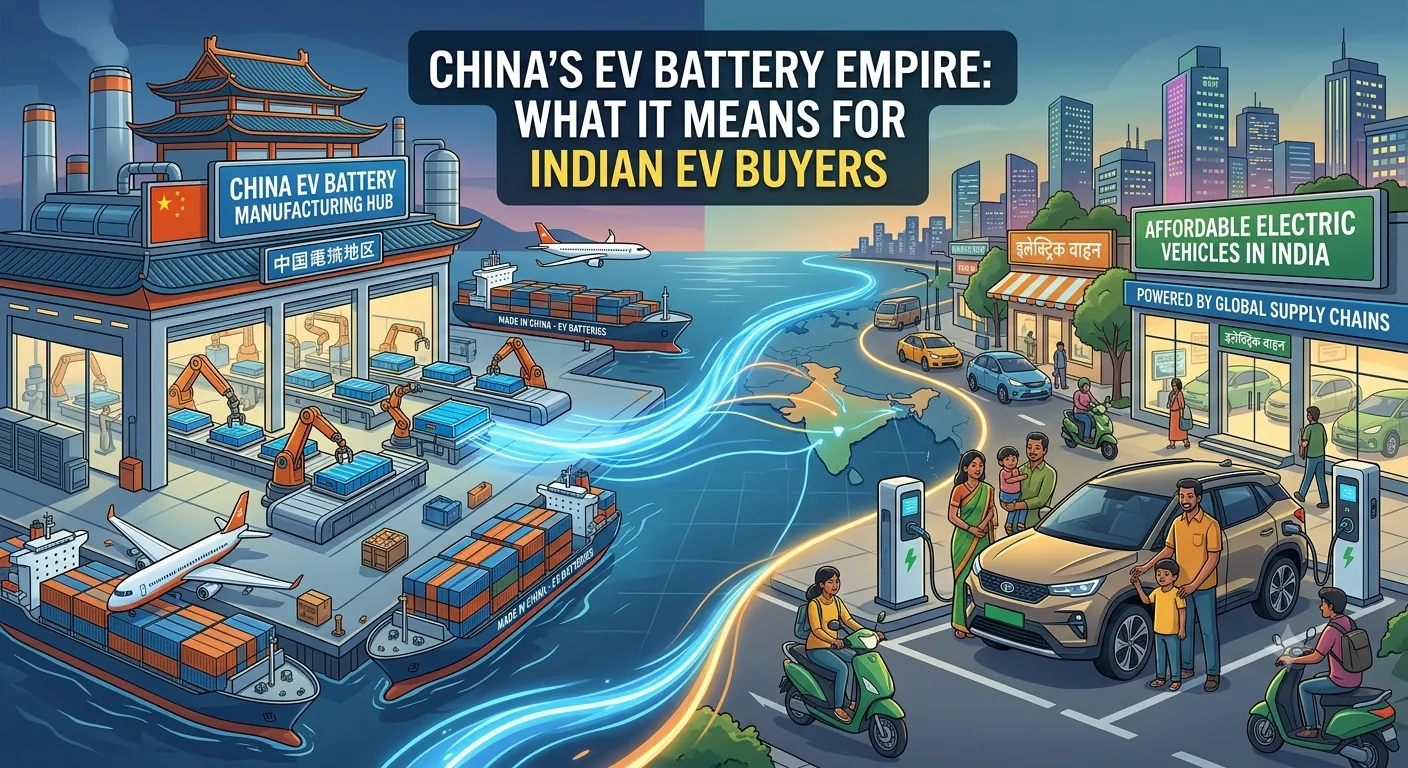
Here is the uncomfortable fact underneath all of it: roughly three in four lithium-ion cells made anywhere on earth come out of a Chinese factory. CATL and BYD alone account for more than half of global capacity. That is not a supply chain detail. It is the reason your Nexon EV, your Windsor EV, and your eC3 cost what they cost, and the reason the next facelift will cost something else.
## Step 1: Separate the car from the cell
Before you compare anything, write down what you are actually buying. An Indian EV in 2026 is three products stacked on top of each other:
- The cell (chemistry, format, where it was made)
- The pack (assembled locally, almost always)
- The car around it (software, service, resale)
China dominates the first layer. India is doing the second. The third is where brands genuinely differ.
**What goes wrong here:** buyers treat "Made in India" on the pack as proof the cells are Indian. It usually is not. Tata and Mahindra assemble packs in Pune and Chakan respectively, but a large share of the cells inside arrive from CATL, BYD, or LG's China plants. That is not a scandal. It is just the truth, and it matters when you are trying to predict whether a price cut is coming.
**How to tell it went wrong:** if a salesperson cannot tell you the cell supplier, they either do not know or do not want to say. Both are useful information.
## Step 2: Build the comparison sheet properly
This is where the spreadsheet earns its keep. List every variant you are considering as a row. Then columns for: ex-showroom price, battery capacity in kWh, claimed range, real-world range (find an owner forum, not the brochure), cell supplier if known, DC fast-charging peak in kW, and warranty years on the pack.
Now the mechanic that saves you an hour. If you have two lists side by side and need to find which entries appear in both, use this in a third column:
```
=IF(ISNUMBER(MATCH(A2,$B$2:$B$50,0)),"Match","No match")
```
Drag it down. Anything returning "Match" exists in both your shortlist and, say, the list of EVs that qualify for a particular state subsidy or a fleet discount. This is the whole trick behind **how to compare two columns in excel for matches**, and it works identically whether you are reconciling variants or checking which models appear on two different dealer quote sheets.
**What goes wrong:** you compare columns that are not the same length, and MATCH returns errors that look like "no match." Anchor your ranges with dollar signs.
**How to tell it went wrong:** every row says "No match." You have a range problem, not a data problem.
## Step 3: Price the China factor into your timeline
Chinese cell prices fell hard through 2024 and 2025 as capacity outran demand. That deflation reached Indian showrooms with a lag, mostly through 2025 and into 2026. The practical effect: pack costs per kWh in India are lower today than at any point in the last four years, and several models have quietly added capacity at the same price rather than cutting the sticker.
| Model type | Typical ex-showroom (INR) | Battery | Cell origin reality |
|---|---|---|---|
| Compact hatch EV | 8.5 to 11 lakh | 25 to 35 kWh | Mostly Chinese cells, Indian pack |
| Compact SUV EV | 12 to 18 lakh | 40 to 60 kWh | Chinese or Korean cells |
| Mid-size SUV EV | 20 to 30 lakh | 60 to 80 kWh | Mixed, some LFP from China |
| Premium | 35 lakh plus | 75 kWh plus | Korean or Chinese, brand dependent |
The goal you are chasing is not the lowest price. It is the lowest price per usable kWh with a service network you can reach.
**What goes wrong:** you anchor on a launch price from 2024 and assume it still holds. It does not. Several models have moved by 40,000 to 80,000 rupees in either direction since.
**How to tell it went wrong:** the dealer quote is higher than the website price. Ask for the on-road breakup in writing before you visit.
## Step 4: Decide whether to buy now or wait
This is the decision the whole exercise exists to reach.
Buy now if you need the car this quarter, your daily run is under 60 km, and you have home charging. Cell prices are unlikely to fall enough in the next six months to justify waiting, and Indian EV prices have started to firm up as local assembly scales.
Wait if you are shopping above 20 lakh. Two things are moving: LFP packs with better cold-weather behaviour, and Indian cell gigafactories that will not meaningfully change prices until 2027 but will change how much of the value chain sits inside the country. Waiting twelve months on a 25 lakh purchase is a reasonable bet. Waiting twelve months on a 9 lakh purchase is not.
**What goes wrong:** you wait for a price cut that arrives as a feature cut instead. Watch for smaller batteries in facelifts, not just lower stickers.
**How to tell it went wrong:** the new variant has the same name, a lower price, and 3 kWh less capacity. Read the spec sheet, not the press release.
## Our take
If you want a compact EV today and the budget is under 15 lakh, the Tata Nexon EV and the Mahindra XUV400 remain the honest picks, and the [MG Windsor](/blog/chinese-ev-tech-in-india-what-it-means-for-buyers-and-market) is worth a test drive if you value interior space over badge. None of them escape Chinese cells, and that is fine. The cells are good.
Above 20 lakh, we would wait. The Hyundai Creta Electric and the [Mahindra BE 6](/blog/2026-india-car-launch-calendar-25-upcoming-models-you-can-t-miss) are both worth watching through 2027, and the case for waiting gets stronger with every gigafactory announcement out of Gujarat and Tamil Nadu.
What we would not do is pay a premium for a car marketed as having a "non-Chinese supply chain." In 2026, at Indian price points, that claim is mostly marketing. The exceptions sit well above 40 lakh, and at that price you are buying something other than transport.
## FAQ
**Does China control the battery in my Indian EV?**
Usually the cell, rarely the pack. Cells from CATL, BYD, or LG's China plants go into packs assembled in India. The car around it is Indian-designed and Indian-built.
**Will EV prices in India fall in 2027?**
Probably not by much. Cell prices have already dropped. The next cost lever is local cell manufacturing, and that scales slowly.
**Should I wait for an Indian-made battery before buying?**
Only if you are spending above 20 lakh and can wait a year. Below that, the car you can charge at home tonight beats the car you might buy in 2027.
Frequently asked questions
Does China control the battery in my Indian EV?
Usually the cell, rarely the pack. Cells from CATL, BYD, or LG's China plants go into packs assembled in India. The car around it is Indian-designed and Indian-built.
Will EV prices in India fall in 2027?
Probably not by much. Cell prices have already dropped. The next cost lever is local cell manufacturing, and that scales slowly.
Should I wait for an Indian-made battery before buying?
Only if you are spending above 20 lakh and can wait a year. Below that, the car you can charge at home tonight beats the car you might buy in 2027.
 CarsbikesPrices